
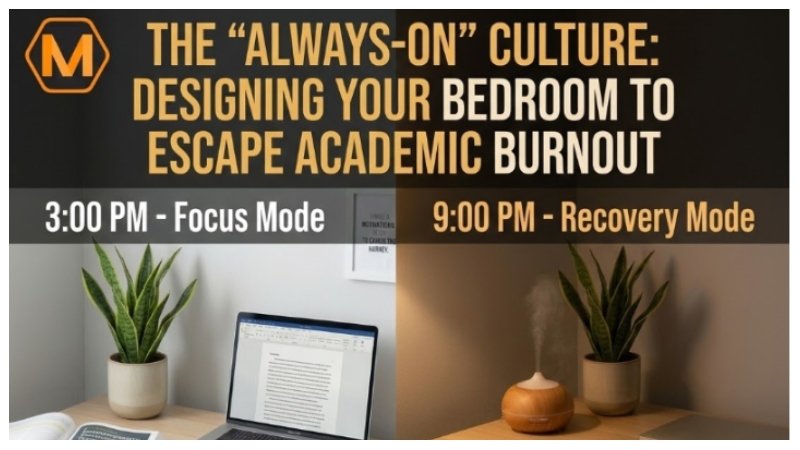
In the fast-paced world of 2026, the boundary between “work” and “home” has almost entirely vanished. For college students, your bedroom isn’t just where you sleep; it’s a lecture hall, a research lab, and a social hub all rolled into one. This “always-on” culture—the feeling that you should be answering emails or tweaking a thesis at 2 AM—is the leading cause of academic burnout. When your pillow is three feet away from your laptop, your brain never truly receives the signal to shut down. To survive a rigorous degree, you have to stop treating your bedroom like an office and start designing it as a recovery suite.
Creating a sanctuary is about more than just buying a nice rug; it’s about psychological segmentation. If you find that your “study-life balance” is nonexistent because of a mounting workload, you aren’t alone. Many students realize that even the best room design can’t fix a schedule that is physically impossible to manage, which is why seeking professional assignment help from a trusted platform like MyAssignmentHelp has become a standard part of a modern student’s self-care toolkit. By delegating some of the heavy lifting, you allow your physical space to actually function as a place of rest rather than a constant reminder of unfinished tasks.
The Sociology of Space: Why Your Room Matters
Social science teaches us that humans are deeply influenced by their environment. In sociology, we call this “spatial cues.” “If you eat, sleep, and study in the exact same spot, your brain experiences ‘cognitive overlap.'” You’ll find yourself thinking about your sociology of education paper while trying to nap, and thinking about sleep while trying to study.
According to environmental psychology, our brains associate specific locations with specific behaviors. To break the burnout cycle, you must create “micro-zones,” even in a tiny dorm room.
The “Three-Zone” Blueprint for Student Success
| Zone Type | Primary Purpose | Design Key | Tech Rule |
| The Sleep Zone | Recovery & Dreaming | High-thread-count sheets, cool temps | No-Tech Zone (No phones/laptops) |
| The Deep Work Zone | Social Science Research | Ergonomic chair, task lighting | Focus Mode (Blocked notifications) |
| The Decompression Zone | Mental Reset | Soft textures, plants, floor cushions | Analog Only (Reading or meditation) |
Lighting Architecture: Resetting Your Circadian Rhythm
Most students suffer from “blue light fatigue.” If you are staring at a screen until the moment you close your eyes, your body won’t produce the melatonin needed for deep sleep. In 2026, smart lighting is a game-changer for student wellness. Use warm, amber-toned bulbs in the evening to signal to your brain that the “academic day” is over.
When you are deep into complex data analysis or writing an ethnographic report, you need high-intensity “cool” light (around 5000K) to stay alert. But the moment that paper is saved, flip the switch to a sunset hue (2700K). This physical transition is a powerful weapon against burnout. It tells your nervous system that the “Always-On” mode is officially toggled off.
Why Social Science Students Face Unique Burnout
Students in the social sciences—majoring in sociology, psychology, political science, or anthropology—often deal with “empathy fatigue.” Unlike a math problem that has a clear “right” answer, a social science paper requires deep emotional and critical labor. You are often researching systemic inequality, historical trauma, or complex human behaviors.
This makes the “always-on” culture even more dangerous because you are carrying the weight of heavy global problems into your sleeping space. When your brain is looping through theories of structural functionalism or psychological stressors at 3 AM, your bedroom ceases to be a sanctuary.
If the mental load of analyzing qualitative data becomes too heavy to process, it is okay to reach out for social science assignment help to ensure your mental health doesn’t suffer for the sake of a grade. This allows you to step back and look at your bedroom as a home again, rather than a data-processing center.
Biophilic Design: The Power of the “Green Reset”
One of the core philosophies we advocate for at ProHomeInsight is that humans are happier when connected to nature. Adding just two or three “low-maintenance” plants—like a snake plant, ZZ plant, or pothos—to your desk can lower your heart rate. This is known as biophilic design.
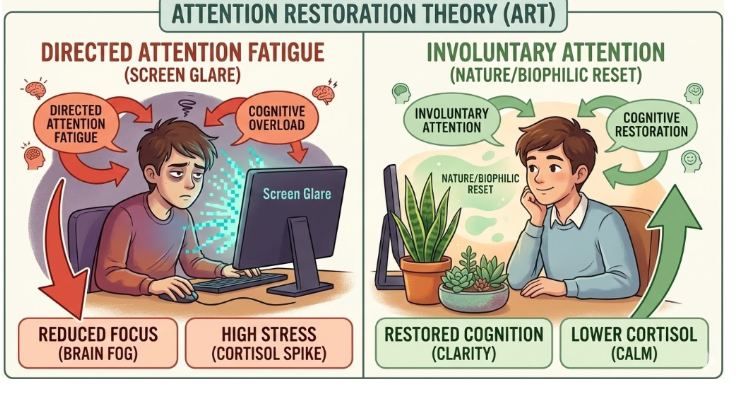
These plants act as a visual “reset” button. When your eyes get tired of looking at 12th-grade-level academic journals or complex spreadsheets, looking at something living and green helps your focus recover. This is scientifically backed by Attention Restoration Theory (ART), which suggests that looking at nature allows the brain to shift from “Directed Attention” (tiring) to “Involuntary Attention” (restorative).
Sensory Engineering: Scent and Sound
To truly escape the “always-on” culture, you must engage all five senses to signal safety and relaxation.
- Olfactory Anchors: Use a diffuser with lavender or cedarwood only when you are done with schoolwork. Over time, your brain will smell these scents and automatically begin to lower your cortisol levels.
- Audio Privacy: In shared living spaces, noise is a major stressor. While “White Noise” is popular, “Brown Noise” is actually better for deep focus during social science research because it has lower frequencies that mask distracting conversations or city traffic.
Minimalist Decor for Maximalist Thinking
A cluttered room leads to a cluttered mind. In the digital age, wcollecton “junk” faster than ever—old PDFs, browser tabs, empty coffee cups, and tangled chargers. To escape burnout, adopt a “Visual Silence” policy.
- Closed Storage: Use bins or drawers to hide your textbooks and laptop at night. If you can’t see your work, you are 40% less likely to stress about it.
- Cable Management: Tangled wires create a “chaos” signal in the brain. Use cable sleeves to streamline your desk setup.
- The “One-In, One-Out” Rule: For every new book or decor item you bring into your room, one must leave. This keeps your sanctuary from becoming a warehouse.
- The Ergonomics of the Mind
Burnout isn’t just mental; it’s physical. Chronic back pain from a bad chair can lead to brain fog.”.” Investing in an ergonomic setup isn’t a luxury; it’s a necessity for long-term academic success. Ensure your monitor is at eye level so your neck remains neutral. When your body is comfortable, your brain can dedicate more energy to the complex critical thinking required for your social science degree.
Furniture Check-list for 2026 Students
- Monitor Arm: To keep the desk surface clear and eyes level.
- Lumbar Support: To prevent “slumped-shoulder” fatigue.
- Footrest: To improve circulation during long research sessions.
Digital Detox: Creating a “Tech-Sabbath”
This “always-on” culture is fueled by notifications. We recommend creating acharging station”n” outside your bedroom if possible. If you must keep your phone in your room, place it in a drawer across the room. This physical barrier prevents the “doom-scrolling” that often happens right before sleep, which is a major contributor to student burnout.
Reclaiming Your Sanctuary
Your bedroom is the most important piece of “real estate” you own during your college years. By implementing smart design choices—like zoning, biophilic elements, and proper lighting—you create a fortress against academic burnout.
It is important to remember that being a successful student in 2026 isn’t about working the hardest; it’s about working the smartest. This involves knowing when your environment needs a makeover and knowing when to seek external support to maintain your peace of mind. Whether you are browsing ProHomeInsight for the latest aesthetic productivity hacks or using professional services to manage your workload, the goal is the same: protecting your mental health.
Conclusion
Don’t let th”always-on”n” culture turn your sanctuary into a prison of deadlines. Start small—move your desk, buy a plant, or hide your laptop after 8 PM. By treating your room with the same respect you treat your GPA, you’ll find that you don’t just survive university—you thrive.
Frequently Asked Questions
How can I separate my study space from my sleep area in a small room?
The most effective way is to create “visual barriers.” Use a tall bookshelf, a folding screen, or even a strategically placed floor plant to block your line of sight between the desk and the bed. Facing your desk away from your sleeping area helps your brain stay in “active mode” during the day and “rest mode” at night.
What kind of lighting is best for reducing academic stress?
A layered lighting approach is ideal. Use bright, cool-toned lights during the day to mimic natural sunlight and boost alertness. As evening approaches, switch to warm, dimmable amber lights. This transition signals your body to reduce cortisol and begin producing melatonin, making it easier to disconnect from the day’s tasks.
Why does a cluttered room contribute to student burnout?
Visual clutter forces the brain to constantly process unnecessary information, which increases your “cognitive load.” When your environment is messy, your mind feels like there is always unfinished work nearby. Keeping surfaces clear and storing academic materials out of sight after hours can significantly lower daily stress levels.
Can indoor plants actually help improve focus on complex tasks?
Yes, plants provide a “micro-rest” for your eyes and mind. Looking at natural greenery for even a few seconds allows your brain to recover from the fatigue of staring at screens or dense text. This simple shift helps restore your attention span and makes it easier to tackle long hours of research or writing.